
Contents
Overview
Born Solomon LeWitt in Hartford, Connecticut, his artistic journey began after serving in the U.S. Army during the Korean War. He studied at Syracuse University, graduating with a degree in fine arts. LeWitt's early career saw him working various jobs, including as a graphic designer and a night-shift typesetter, experiences that likely informed his later systematic approach to art-making. He moved to New York City in the early 1950s, immersing himself in the burgeoning art scene and encountering figures who would shape his thinking, such as George Brecht and Robert Rauschenberg. His formative years were marked by a deep engagement with art history and a growing dissatisfaction with the expressive, gestural qualities of Abstract Expressionism, pushing him towards a more structured, intellectual practice.
⚙️ How It Works
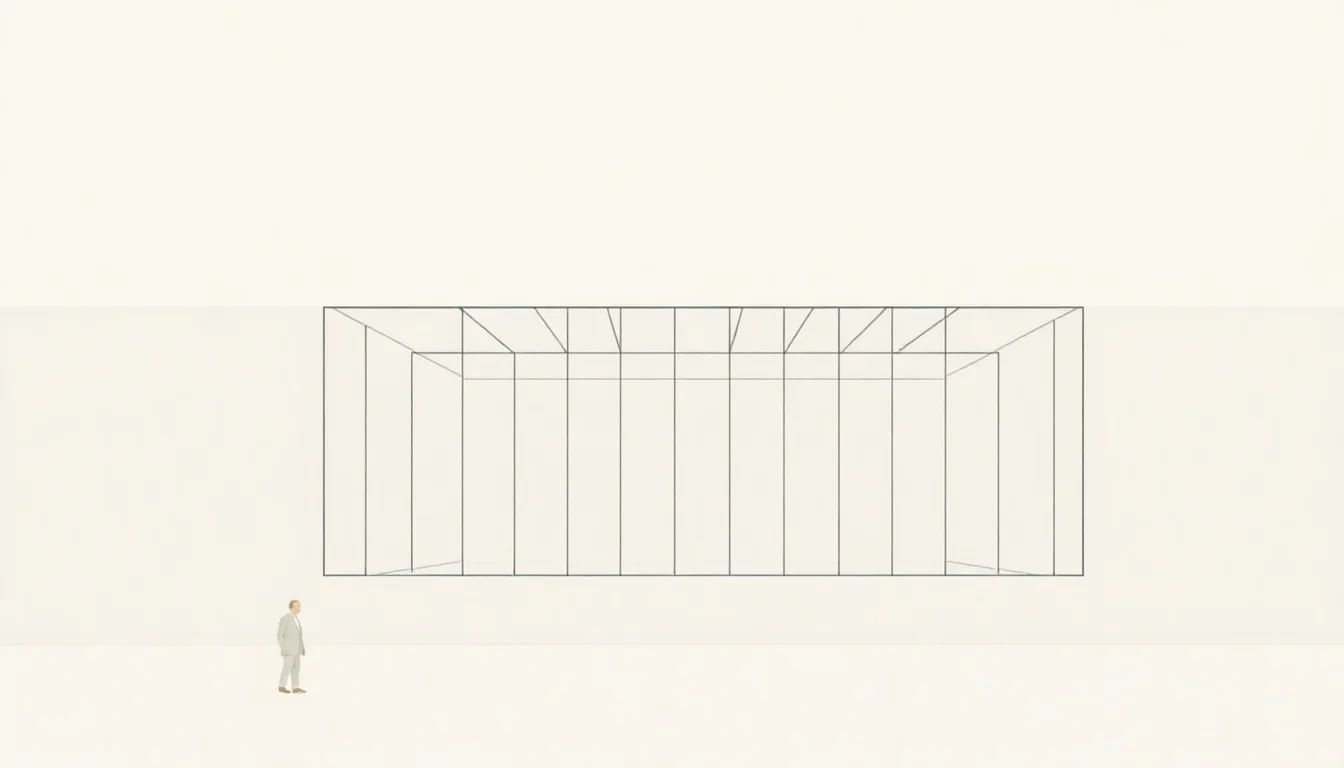
LeWitt's artistic method revolved around the concept that the idea is the machine that makes the art. He famously stated, "The idea becomes a machine that makes the art." His "structures," often modular and geometric, were conceived as three-dimensional grids or forms that could be fabricated from materials like aluminum or wood. More significantly, his wall drawings were based on precise instructions he provided. These instructions, often complex and detailed, specified colors, lines, shapes, and their placement, allowing teams of assistants to realize the work. This process shifted the focus from the artist's manual skill to the conceptual framework, emphasizing the plan over the execution and challenging the traditional definition of an artist's unique touch. The execution of these works often involved meticulous planning and collaboration, turning the act of installation into a performance of the concept itself.
📊 Key Facts & Numbers
LeWitt's prolific career yielded an estimated 3,500 works, including over 1,200 wall drawings, 100 structures, and thousands of prints and artist's books. By 1965, he had already begun exhibiting his work internationally, with hundreds of solo exhibitions held in museums and galleries worldwide throughout his lifetime and posthumously. His structures often utilized modular units, with some of his early modular structures comprising up to 125 cubes. The scale of his wall drawings could range from a few square feet to entire buildings, with some projects spanning over 10,000 square feet. His artist's books, numbering in the hundreds, were integral to his practice, often containing diagrams, instructions, and conceptual explorations, with some editions produced in runs of over 1,000 copies.
👥 Key People & Organizations
Key figures in Sol LeWitt's orbit included his spouse, Carol LeWitt, who was an artist and gallerist, and his daughter, Eva LeWitt, who has continued to manage his estate and promote his work. He was educated at Syracuse University and later taught at New York University in the 1960s, influencing a generation of students. His early artistic development was significantly shaped by his interactions with fellow artists in the Fluxus movement and the downtown New York art scene, including Joseph Kosuth, Douglas Huebler, and Lawrence Weiner, all of whom were exploring conceptual approaches to art. The Museum of Modern Art (MoMA) and the Solomon R. Guggenheim Museum in New York are among the many major institutions that hold his works in their permanent collections.
🌍 Cultural Impact & Influence
LeWitt's conceptual approach fundamentally altered the trajectory of contemporary art, particularly influencing conceptual art, minimalism, and post-minimalism. His emphasis on the idea over the object paved the way for artists to explore process, systems, and instruction-based art. His wall drawings, in particular, have been reinstalled in countless institutions, demonstrating the enduring power of his conceptual framework and the collaborative nature of art-making. The widespread adoption of his systematic methodologies can be seen in the work of artists who employ grids, seriality, and predetermined rules. His influence extends beyond visual arts, touching upon fields like architecture and design, where systematic planning and modularity are paramount. The Sol LeWitt Foundation in Chester, Connecticut, continues to preserve and promote his legacy, ensuring his ideas remain accessible.
⚡ Current State & Latest Developments
In the years following LeWitt's death in 2007, his work has continued to be exhibited and reinterpreted globally. Major retrospectives, such as the 2017 exhibition "Sol LeWitt: Wall Drawings, 1968–2007" at the Museum of Modern Art (MoMA), have reaffirmed his significance. Institutions like the Dia Art Foundation have ongoing installations of his structures, such as "Wall/Floor/Ceiling" (1970) at Dia Beacon. There's a persistent interest in the meticulous execution of his wall drawings, with ongoing projects at various museums and galleries worldwide, often involving trained teams of installers who adhere strictly to his original instructions. The market for his works remains robust, with significant pieces frequently appearing at auction and in gallery exhibitions, underscoring his lasting appeal and value in the art world.
🤔 Controversies & Debates
A central debate surrounding LeWitt's work concerns the nature of authorship and originality. Critics sometimes question the extent to which assistants executing his instructions are truly "making" the art, or if LeWitt himself is the sole author. This tension between the artist's concept and the labor of execution is a core aspect of his practice. Another point of discussion is the preservation and reinstallation of his wall drawings; while designed to be temporary, their repeated execution raises questions about authenticity and the role of the physical object versus the enduring idea. Some art historians also debate the precise lineage of his conceptualism, tracing its roots through Marcel Duchamp's readymades and the Fluxus movement, while others emphasize LeWitt's unique systematic rigor as a departure from these precedents. The sheer volume and systematic nature of his output also invite analysis regarding artistic production and its relationship to industrial processes.
🔮 Future Outlook & Predictions
The future of LeWitt's legacy appears secure, anchored by the Sol LeWitt Foundation's commitment to preserving his archives and facilitating the realization of his works. As digital technologies advance, there's potential for new interpretations or documentation methods for his instruction-based pieces, though the emphasis will likely remain on physical execution. The ongoing reinstallation of his wall drawings ensures his work remains present in the contemporary art landscape. Furthermore, his systematic approach continues to inspire artists working with algorithms, generative design, and artificial intelligence in art, suggesting his conceptual framework will remain relevant for artists exploring the intersection of ideas, systems, and creation. The enduring appeal of his geometric structures also points to continued interest in their architectural and sculptural qualities.
💡 Practical Applications
LeWitt's work has direct practical applications in art education, serving as a prime example of conceptual art and the importance of ideas in creative practice. His instruction-based pieces are used in classrooms to teach students about process, collaboration, and the dematerialization of art. Beyond art, his systematic and modular approach has influenced architectural design, particularly in modular construction and urban planning, where efficiency and replicability are key. The principles of his work can be seen in graphic design and product design, where clear instructions and repeatable units are essential for mass production and consistent branding. His artist's books also serve as practical models for self-publishing and conceptual documentation within creative fields.
Key Facts
- Category
- aesthetics
- Type
- topic