
Contents
Overview
Societal collapse isn't a single event, but a complex process where a society loses its ability to function at a fundamental level. This can manifest as the breakdown of political structures, economic systems, social cohesion, or even the loss of essential services. Vibepedia tracks the historical precedents, from the Bronze Age Collapse to the fall of the Roman Empire, and analyzes contemporary concerns like climate change, resource depletion, and geopolitical instability. We explore the warning signs, the mechanisms of decay, and the potential for societal resilience or transformation. Understanding collapse is crucial for navigating the present and anticipating future societal trajectories.
🌍 What is Societal Collapse?
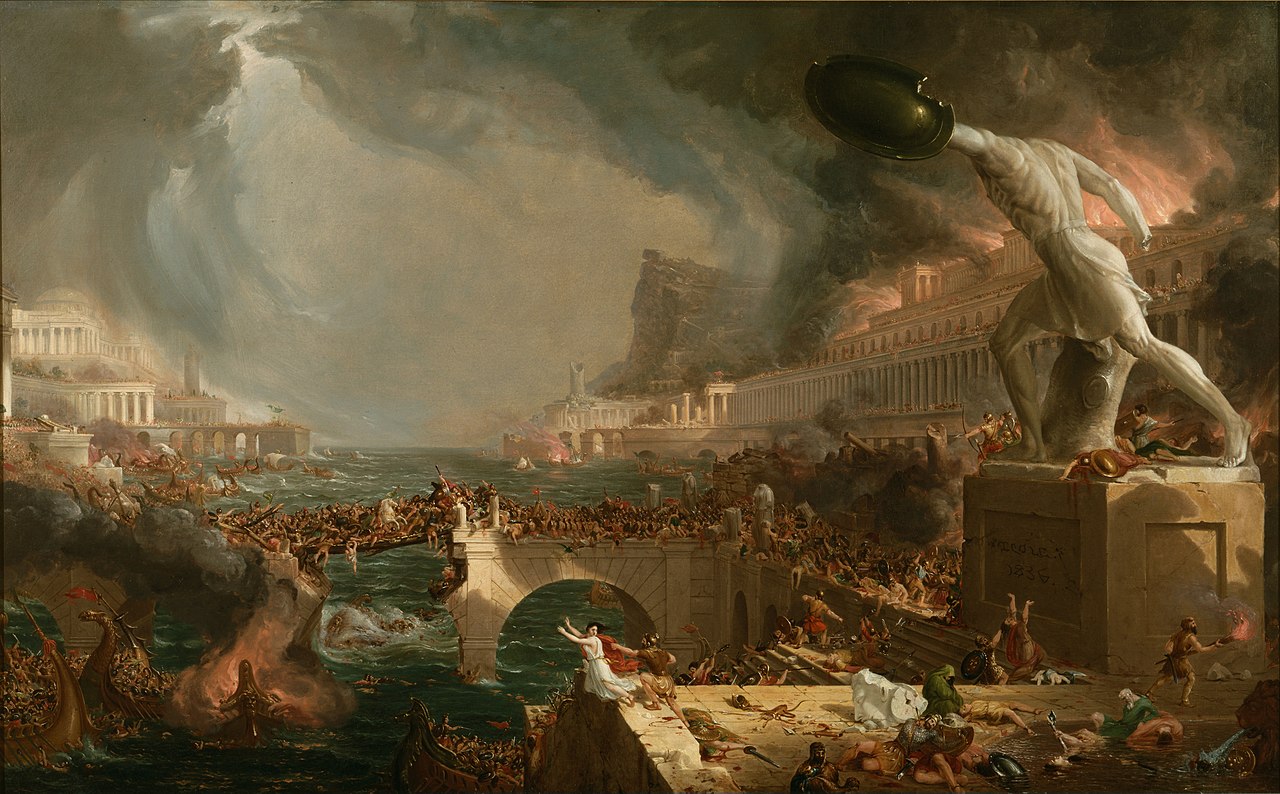
Societal collapse, at its core, signifies the disintegration of a complex human society. This isn't just a bad economy or a political upheaval; it's a fundamental loss of cultural identity and the breakdown of social structures that allow for adaptation and survival. Think of it as the system failing so profoundly that its ability to function as a cohesive unit evaporates, often leading to widespread violence and a reversion to simpler, more precarious ways of life. This can manifest as the downfall of established governments, the erosion of shared values, and a struggle for basic resources. It's the ultimate loss of social capital.
🚨 Why This Matters Now
Understanding societal collapse isn't an academic exercise for the detached observer; it's a vital primer for navigating the present and future. We're witnessing unprecedented levels of global interconnectedness, coupled with escalating climate change impacts, resource scarcity, and geopolitical instability. The speed at which information (and misinformation) spreads, the fragility of global supply chains, and the sheer scale of potential disruptions mean that the warning signs of collapse are more visible and potentially more imminent than ever before. Ignoring these signals is akin to ignoring a structural fault line in your home.
🔍 Key Drivers of Collapse
The causes of collapse are rarely singular; they are typically a confluence of interacting stressors. Historically, we've seen natural catastrophes like supervolcano eruptions or asteroid impacts trigger widespread societal breakdown. More commonly, however, collapse stems from a combination of warfare, pandemics, economic crises, and environmental degradation. Population overshoot and unsustainable resource consumption create inherent vulnerabilities, while incompetent leadership or external sabotage can act as the final domino. The interplay between these factors is crucial to understanding any specific instance of collapse.
📈 Historical Precedents
History offers a stark catalog of societies that have succumbed to collapse. The Bronze Age Collapse around 1200 BCE saw the rapid decline of major civilizations across the Eastern Mediterranean, including the Mycenaeans and the Hittites, with causes still debated but likely involving a complex mix of invasions, climate shifts, and internal strife. Later, the Western Roman Empire's fall in 476 CE, while a drawn-out process, fundamentally reshaped Europe. Even seemingly robust empires like the Maya civilization experienced periods of significant decline and abandonment of major urban centers. Studying these precedents provides invaluable context for current trends.
📉 The Collapse Spectrum
Societal collapse isn't a binary event; it exists on a spectrum. Some societies experience partial collapse, where certain institutions fail but others endure, leading to a period of instability and restructuring. Others face total collapse, resulting in the complete disappearance of the society or its absorption into a more resilient neighbor. The Vibepedia Collapse Spectrum categorizes these outcomes, from minor disruptions with swift recoveries to complete societal dissolution. Understanding where a society sits on this spectrum is key to assessing its resilience and potential future trajectory.
💡 Vibepedia's Unique Take
At Vibepedia, we don't just catalog collapse; we analyze the vibe of it. We map the influence flows of ideas and behaviors that either hasten or mitigate collapse. Our Controversy Spectrum highlights the ongoing debates surrounding the causes and inevitability of collapse, from techno-optimists who believe in perpetual innovation to prepper communities preparing for the worst. We use Vibe Scores to measure the cultural energy and collective consciousness surrounding these topics, offering a unique lens on societal anxieties and resilience.
📚 Recommended Reading & Resources
To truly grasp the complexities of societal collapse, engage with the foundational texts and contemporary analyses. Jared Diamond's Collapse: How Societies Choose to Fail or Succeed remains a seminal work, exploring environmental factors. For a more historical perspective, consider Joseph Tainter's The Collapse of Complex Societies. Contemporary thinkers like Nassim Nicholas Taleb offer insights into black swan events and systemic fragility. Vibepedia also curates extensive resource lists and expert interviews on related topics like resilience engineering and post-collapse societies.
🗣️ Join the Conversation
The conversation around societal collapse is often fraught with anxiety, but it's also a space for critical thinking and proactive planning. Vibepedia encourages active participation in our forums and community discussions. Share your insights, debate the evidence, and connect with others who are exploring these critical issues. Whether you're interested in historical case studies, futurist scenarios, or practical preparedness strategies, your voice contributes to a richer understanding of our collective trajectory. How are you preparing for the future?
Key Facts
- Year
- 2024
- Origin
- Vibepedia.wiki
- Category
- Sociology & Geopolitics
- Type
- Topic Guide
Frequently Asked Questions
Is societal collapse inevitable?
The inevitability of societal collapse is one of the most hotly debated topics. While history shows numerous examples of societies collapsing, proponents of resilience engineering argue that proactive measures and adaptive strategies can mitigate risks. Vibepedia's Controversy Spectrum highlights the range of views, from deterministic pessimism to optimistic calls for systemic change. Ultimately, whether collapse is inevitable may depend on collective human action and our ability to address systemic vulnerabilities.
What's the difference between societal collapse and a recession?
A recession is a significant decline in economic activity, typically lasting more than a few months. Societal collapse is far more profound, involving the breakdown of fundamental social structures, loss of cultural identity, and often a reversion to more primitive living conditions. While a recession can be a contributing factor to collapse, collapse implies a systemic failure that affects governance, social order, and the very fabric of a civilization, not just its economic output.
How does Vibepedia measure 'vibe' in relation to collapse?
Vibepedia's Vibe Scores are a proprietary metric that attempts to quantify the collective cultural energy, sentiment, and awareness surrounding a given topic. In the context of societal collapse, a high vibe score might indicate widespread public anxiety, intense media focus, or a surge in related cultural production (films, books, online discussions). Conversely, a low score might suggest public apathy or a lack of widespread concern, even if objective risk factors are high. It's a measure of cultural resonance, not necessarily predictive accuracy.
Are there any societies that have successfully averted collapse?
Defining 'success' in averting collapse is complex. Some societies have undergone significant transformations and periods of instability without complete dissolution, adapting to new challenges. For instance, post-WWII Japan and Germany rebuilt their societies after near-total destruction. The Scandinavian model is often cited for its social cohesion and resilience. However, these societies still face ongoing challenges, and the long-term trajectory of any complex system remains subject to numerous variables. Vibepedia explores these case studies through its historical precedents section.
What are the most common signs of impending collapse?
Common indicators include rapid economic inequality, widespread political polarization, erosion of trust in institutions, environmental degradation (like water scarcity or soil depletion), increasing frequency of extreme weather events, breakdown of supply chains, and rising levels of social unrest or violence. A significant decline in infant mortality rates can also be a lagging indicator of systemic stress. Vibepedia's analysis often focuses on the interplay of these factors.