
Contents
Overview
The concept of phase transitions, while now a cornerstone of physics, emerged gradually from observations of everyday phenomena. Early chemists and physicists noted the distinct behaviors of solids, liquids, and gases, but it was the rigorous thermodynamic framework developed in the 19th century that formalized these changes. Josiah Willard Gibbs, an American physicist, introduced concepts like phase diagrams and free energy to describe equilibrium conditions. His work provided a mathematical language for understanding why substances change state under specific conditions. Later, Max Planck and Albert Einstein further refined these ideas, contributing to the broader understanding of thermodynamics and statistical mechanics that underpins modern phase transition theory. The study expanded beyond simple states of matter to encompass more complex phenomena, such as superconductivity and magnetism, in the 20th century.
⚙️ How It Works
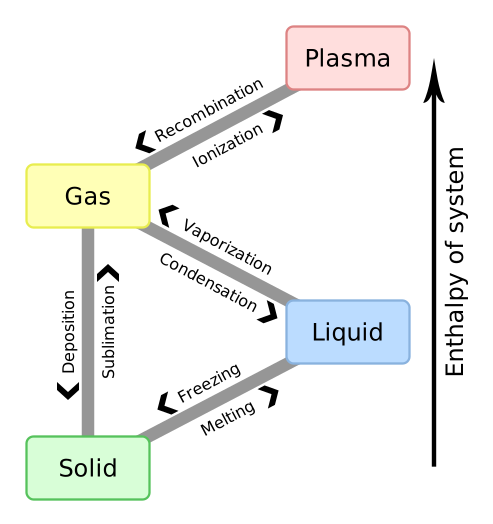
At its heart, a phase transition occurs when a system's macroscopic properties change abruptly due to a small alteration in external parameters like temperature, pressure, or magnetic field. These changes are often driven by energy considerations; a system seeks its lowest energy state. For instance, heating ice (solid) increases the kinetic energy of its water molecules. These transitions can be classified by their order: first-order transitions involve a latent heat and a discontinuity in properties like volume, while second-order (or continuous) transitions have no latent heat and show discontinuities in derivatives of thermodynamic potentials, like specific heat.
📊 Key Facts & Numbers
Phase transitions are quantified by specific critical points and latent heats. The critical phenomena, observed near continuous phase transitions, exhibit universal behavior described by critical exponents, which are often independent of the specific material. For example, critical phenomena in water exhibit universal behavior.
👥 Key People & Organizations
Several key figures and institutions have shaped our understanding of phase transitions. Josiah Willard Gibbs was an American physicist. Lev Landau (1908-1968), a Soviet theoretical physicist, developed a widely influential theory of second-order phase transitions based on an order parameter. Kenneth G. Wilson (1936-2013) won the Nobel Prize in Physics for his work on critical phenomena using the renormalization group, a powerful mathematical tool for understanding systems at different scales. Research continues at institutions like MIT, Stanford University, and Max Planck Institutes worldwide, exploring exotic phases and their applications.
🌍 Cultural Impact & Influence
The concept of phase transitions permeates culture and language, often used metaphorically to describe significant societal or personal changes. The dramatic transformation of water into steam, for instance, has inspired countless artistic and literary works, symbolizing power, change, and the sublime. In engineering and industry, the controlled manipulation of phase transitions is fundamental to processes like metallurgy, chemical synthesis, and refrigeration. The discovery of new phases of matter, such as Bose-Einstein condensates and topological insulators, has captured the public imagination, hinting at future technological revolutions. The very notion of distinct states of matter, from the solid stability of ice to the gaseous freedom of steam, provides a basic framework for understanding the physical world around us.
⚡ Current State & Latest Developments
Current research in phase transitions is pushing the boundaries of known physics and materials science. Scientists are actively investigating quantum phase transitions, which occur at absolute zero temperature and are driven by quantum fluctuations rather than thermal energy. This includes exploring phenomena like superconductivity and superfluidity in novel materials. The development of metamaterials with engineered electromagnetic properties also involves phase-transition-like behaviors. Furthermore, researchers are applying phase transition principles to understand complex systems, from the dynamics of biological cells to the formation of galaxies. The ongoing exploration of high-entropy alloys, which exhibit unique phase stability, is a prime example of materials science innovation driven by phase transition understanding.
🤔 Controversies & Debates
The classification and understanding of phase transitions are not without debate, particularly concerning the precise definition of different orders and the behavior near critical points. The universality of critical exponents, while widely accepted, has been refined and challenged by more complex models and experimental data. Another area of contention is the nature of the transition between liquid and gas at the critical point itself, where the distinction blurs. In condensed matter physics, the exact mechanisms driving some quantum phase transitions in complex materials remain an active area of research, with competing theoretical models. The role of disorder in phase transitions also presents ongoing theoretical challenges, as it can fundamentally alter transition behavior.
🔮 Future Outlook & Predictions
The future of phase transition research promises advancements in materials science, quantum computing, and energy technologies. Scientists anticipate discovering new quantum phases of matter with exotic properties, potentially leading to breakthroughs in areas like fault-tolerant quantum computation and novel electronic devices. The development of materials that can undergo controlled phase transitions at room temperature could revolutionize energy storage and conversion. Furthermore, understanding phase transitions in astrophysical contexts, such as the behavior of matter in neutron stars or the early universe, will continue to refine our cosmological models. Predictive modeling of complex phase diagrams for multi-component alloys and chemical systems will also become increasingly sophisticated, enabling targeted material design.
💡 Practical Applications
Phase transitions are indispensable in a vast array of practical applications. In the kitchen, boiling water for pasta or freezing water for ice cubes are everyday examples. Industrially, the process of distillation, crucial for separating liquids with different boiling points, relies on repeated vaporization and condensation. Refrigeration and air conditioning systems exploit the phase transition of refrigerants from liquid to gas to absorb heat. Metallurgy heavily depends on controlling phase transitions in metals and alloys to achieve desired properties like strength and hardness through processes like heat treatment. The development of semiconductor devices also involves precise control over phase transitions during crystal growth and doping. Even weather patterns, like cloud formation and precipitation, are direct results of water's phase transitions.
Key Facts
- Category
- science
- Type
- topic