
Contents
Overview
The genesis of the Kumbh Mela is steeped in Hindu mythology, specifically the tale of the Samudra Manthana, the churning of the cosmic ocean of milk. During this epic event, gods and demons vied for the amrita, the elixir of immortality. Drops of this divine nectar are said to have fallen at four specific locations: Prayagraj (then known as Allahabad), Haridwar, Nashik, and Ujjain. These sites became sacred, and the Mela commemorates this celestial event, with its timing determined by the complex movements of Jupiter, the Sun, and the Moon. The earliest textual references to the Kumbh Mela are found in the writings of the Chinese traveler Xuanzang in the 7th century CE, who described a similar festival during his visit to India. Over centuries, the Mela evolved from a localized religious observance into a massive, pan-Indian spiritual congregation, attracting diverse ascetic orders like the Naga Sadhus and various philosophical schools.
⚙️ How It Works
The Kumbh Mela's timing is a marvel of ancient Indian astrology, governed by the positions of Jupiter, the Sun, and the Moon. A 'Purna Kumbha' (full pitcher) Mela occurs every twelve years at each of the four sites, while an 'Ardh Kumbha' (half pitcher) Mela happens every six years at Prayagraj and Haridwar. The specific dates are calculated based on the zodiacal positions: when Jupiter enters Leo and the Sun enters Aries, it signals the Mela at Haridwar; when Jupiter is in Scorpio and the Sun in Aries, it's Ujjain; when Jupiter is in Taurus and the Sun in Aries, it's Nashik; and for Prayagraj, the most significant, it's when Jupiter is in Aries, the Sun in Aquarius, and the Moon is new (Amavasya). The most auspicious bathing day, the 'Shahi Snan' or royal bath, is determined by these astrological configurations, drawing the largest throngs of pilgrims.
📊 Key Facts & Numbers
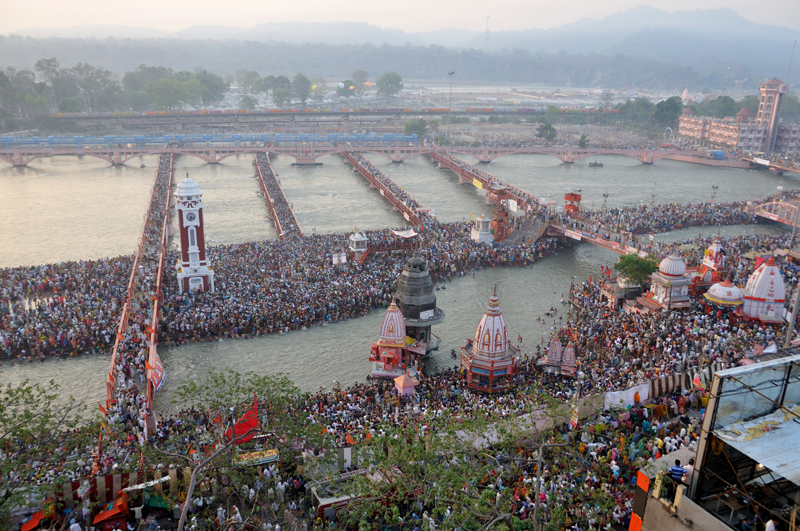
The scale of the Kumbh Mela is staggering. Managing such a colossal influx requires immense logistical planning, involving thousands of temporary police officers, medical personnel, and sanitation workers. The economic impact is also significant, with local economies experiencing a massive surge in revenue from tourism, accommodation, and vendor sales, estimated to be in the billions of Indian Rupees.
👥 Key People & Organizations
While no single person 'owns' the Kumbh Mela, its spiritual leadership is often associated with various monastic orders and their leaders. The Akhil Bharatiya Akhara Parishad (ABAP) is a prominent council representing the various akharas (monastic orders) that participate. Key figures often include the Mahants and Acharyas of these akharas, such as the Naga Sadhus, who lead the most anticipated processions. Government bodies like the Uttarakhand Government and Uttar Pradesh Government play crucial roles in organizing and managing the event, often establishing dedicated Mela authorities. International organizations like UNESCO have also become key stakeholders, recognizing its cultural significance.
🌍 Cultural Impact & Influence
The Kumbh Mela's cultural resonance extends far beyond India's borders. It serves as a powerful symbol of Hindu identity and devotion, influencing art, literature, and philosophy. It provides a unique platform for the transmission of ancient traditions, spiritual teachings, and ascetic practices from one generation to the next. The sheer spectacle of millions gathering for a shared spiritual purpose has captivated global media and inspired countless documentaries and travelogues, fostering a broader understanding of Indian spirituality and its diverse expressions. The concept of mass spiritual gatherings has also influenced other religious and cultural events worldwide.
⚡ Current State & Latest Developments
Preparations are well underway for the Maha Kumbh Mela scheduled for 2025, also in Prayagraj, with projections suggesting it could be the largest gathering in history. Security and crowd management remain paramount concerns, with authorities constantly innovating crowd control techniques and leveraging technology, including AI-powered surveillance, to ensure safety. The ongoing development of infrastructure around these pilgrimage sites is a continuous process, aiming to accommodate the ever-increasing number of devotees.
🤔 Controversies & Debates
The Kumbh Mela, despite its spiritual aura, is not without its controversies. Stampedes, tragically, have occurred due to the sheer density of the crowds, leading to loss of life and raising questions about crowd management protocols. Concerns are also frequently raised about sanitation and environmental impact, given the massive influx of people and the temporary nature of the infrastructure. The role and visibility of certain ascetic groups, particularly the Naga Sadhus and their public nudity, sometimes draw criticism or discomfort from more conservative segments of society and international observers. Furthermore, the commercialization of the Mela, with increasing corporate sponsorship and tourism, sparks debate about the dilution of its spiritual essence.
🔮 Future Outlook & Predictions
The future of the Kumbh Mela is likely to be shaped by the interplay of tradition and modernity. As global interest grows, so too will the logistical challenges and the need for advanced technological solutions in crowd management, waste disposal, and public health. The spiritual significance is expected to endure, with increasing emphasis on sustainable practices and minimizing environmental impact. There's also a growing trend towards digital integration, with apps and online platforms providing information and facilitating virtual participation for those unable to attend physically. The Mela may also see a greater influx of international spiritual seekers, further diversifying its attendees. The challenge will be to preserve its sacred character while adapting to the demands of a rapidly changing world and an ever-expanding global audience.
💡 Practical Applications
The Kumbh Mela is a powerful demonstration of faith and a logistical masterpiece. Its primary 'application' is spiritual: providing a sacred space for millions to cleanse themselves of sins through ritual bathing in holy rivers, seeking spiritual liberation, and connecting with deities. Beyond the spiritual, it serves as a vital platform for the preservation and transmission of Hindu traditions, philosophies, and ascetic practices. The event also functions as a significant economic driver for the host regions, boosting local economies through tourism and trade. For the government, it's a massive exercise in public administration, disaster management, and infrastructure development, showcasing India's capacity to manage large-scale events. It also acts as a global ambassador for Indian culture and spirituality, attracting international attention and fostering cross-cultural understanding.
Key Facts
- Category
- culture
- Type
- topic