
Contents
- 🎵 Origins & History
- ⚙️ How It Worked (Theoretically)
- 📊 Key Facts & Numbers
- 👥 Key People & Organizations
- 🌍 Cultural Impact & Influence
- ⚡ Current State & Latest Developments
- 🤔 Controversies & Debates
- 🔮 Future Outlook & Predictions
- 💡 Practical Applications (Conceptual)
- 📚 Related Topics & Deeper Reading
- References
Overview
The legend of the Hanging Gardens is primarily rooted in the accounts of ancient Greek and Roman writers. While the most detailed narrative attributes their creation to King Nebuchadnezzar II, who ruled the Neo-Babylonian Empire, the motive was reportedly to please his Median wife, Queen Amytis, who longed for the green, mountainous landscapes of her homeland. These descriptions paint a picture of a sophisticated irrigation system, possibly employing Archimedes' screw or similar devices, to lift water to the highest terraces. However, the lack of direct Babylonian records mentioning such a monumental structure, coupled with the absence of archaeological proof in Babylon itself, has fueled centuries of skepticism and alternative theories, including the possibility that the gardens were located in Nineveh and built by the Assyrian king Sennacherib.
⚙️ How It Worked (Theoretically)
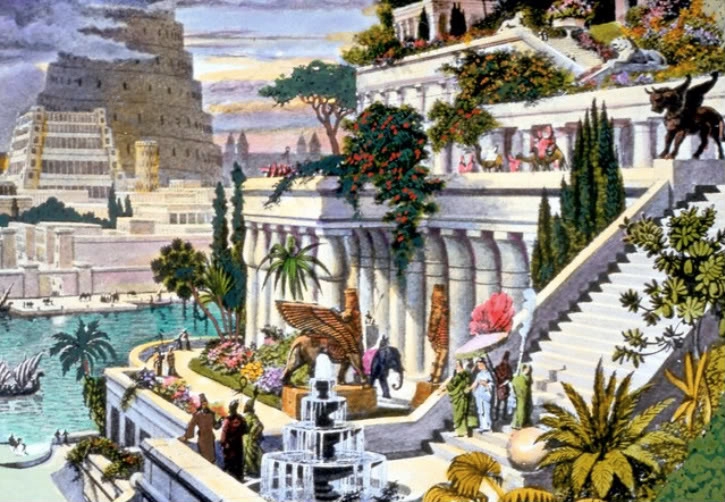
The engineering marvel of the Hanging Gardens, as described, would have required an advanced understanding of hydraulics and structural integrity. Ancient texts suggest a complex system of terraces built from mud bricks, supporting a vast array of flora. Water was likely pumped from the Euphrates River using a chain of buckets or a screw mechanism, a feat that would have demanded significant power and continuous operation. The tiered design would have created a microclimate, allowing for the cultivation of diverse plant life, from towering trees to delicate vines, all cascading down the structure. This theoretical design, if realized, would have been a remarkable display of human ingenuity in arid Mesopotamia, transforming a flat landscape into a lush, artificial mountain.
📊 Key Facts & Numbers
While precise dimensions are debated, descriptions suggest a structure potentially hundreds of feet high, covering an area of several acres. The sheer volume of water required to sustain such a garden would have been immense, estimated to be thousands of gallons per day. The construction materials, primarily mud bricks, would have necessitated robust waterproofing and structural support to prevent collapse under the weight of soil and vegetation, a challenge that still baffles modern engineers.
👥 Key People & Organizations
Key figures associated with the Hanging Gardens are primarily the historians who documented them, rather than builders or rulers directly. King Nebuchadnezzar II is the most commonly cited builder, though this attribution is heavily debated. His wife, Queen Amytis, is named as the recipient of this grand gesture. Ancient writers like Berossus, Diodorus Siculus, and Strabo provided the most detailed accounts, though they wrote centuries after the supposed construction. The Assyrian king Sennacherib has also been proposed as a potential builder, with his palace at Nineveh exhibiting features that align with some descriptions.
🌍 Cultural Impact & Influence
The enduring mystique of the Hanging Gardens has cemented its place in global culture, inspiring countless works of art, literature, and even modern architectural concepts. Its status as a Wonder of the Ancient World has fueled imaginations for millennia, symbolizing the pinnacle of ancient achievement and the allure of lost civilizations. The narrative of a king building a paradise for his queen has become a romantic archetype, influencing storytelling across various media. Furthermore, the very debate surrounding its existence has made it a fascinating case study in historical interpretation, archaeology, and the power of legend to outlast physical evidence, influencing how we approach the study of ancient history and the archaeology of the ancient Near East.
⚡ Current State & Latest Developments
Despite extensive archaeological surveys of Babylon and surrounding regions, no definitive physical evidence of the Hanging Gardens has ever been unearthed in Babylon. This ongoing lack of concrete proof continues to be the central point of discussion. While some scholars propose that the gardens might have been located in Nineveh, a theory supported by reliefs found there depicting elaborate gardens, the traditional association with Babylon remains potent. The search for the 'lost wonder' continues, with new technologies and analytical methods potentially offering fresh perspectives on the available textual and archaeological data, keeping the legend alive in the 21st century.
🤔 Controversies & Debates
The primary controversy surrounding the Hanging Gardens is their very existence in Babylon. Historians and archaeologists are divided: some accept the ancient accounts at face value, attributing the lack of evidence to the destructive nature of time or misidentification. Others, like Dr. Irving Finkel of the British Museum, argue that the gardens may have been a purely literary creation or a conflation of different structures. The theory that the gardens were actually built by Sennacherib in Nineveh is a significant point of contention, challenging the traditional narrative and suggesting a potential geographical and historical misattribution that has persisted for over two millennia. This debate highlights the challenges of reconstructing ancient history from fragmented and often biased sources.
🔮 Future Outlook & Predictions
The future outlook for the Hanging Gardens of Babylon remains firmly in the realm of historical inquiry and speculative reconstruction. While direct archaeological discovery in Babylon seems increasingly unlikely, ongoing research into Assyrian records and potential garden structures in Nineveh might offer new clues. Future advancements in remote sensing technology and geophysical survey techniques could potentially reveal hidden structures or water management systems in either location. However, it is more probable that the Hanging Gardens will continue to exist primarily as a powerful legend, a symbol of lost grandeur and the enduring human fascination with the extraordinary achievements of the past, influencing future conceptual designs for urban green spaces.
💡 Practical Applications (Conceptual)
While the Hanging Gardens themselves may not be replicable in their legendary form, the concept of elevated, multi-tiered gardens and sophisticated irrigation has found numerous practical applications throughout history and into the modern era. Examples include hanging baskets and vertical gardens in contemporary urban design, which maximize green space in limited areas. The principles of water management and creating microclimates, as theorized for the Gardens, are fundamental to modern hydroponics and aquaponics systems, as well as advanced green roof technology. The romantic ideal of a lush oasis in an arid environment continues to inspire landscape architects and urban planners worldwide.
Key Facts
- Category
- history
- Type
- topic